Showing posts with label American Art. Show all posts

Friday, May 18, 2018

Pulp Covers by Norman Saunders


This surprisingly revealing cover was for a nineteen thirties pulp US magazine. Painted by pulp art supremo Norman Saunders (1907-1989), it appeared as the cover for the December 1936 issue of Saucy Movie Tales.  The other covers here are all from 1936 and 1937.


So called because of the cheap wood pulp paper on which they were printed, pulp magazines flourished in the United States from the end of the nineteenth century until the late fifties. Typically, as the case with Saucy Movie Tales,  they were 128 pages long and were in a 7" by 10" format.


Some of the magazines focussed on different genres, such as adventure, westerns, detective, science fiction and romance but many included a mixture of genres. In theory, Saucy Movie Tales was supposed to concentrate on tales of starlets, directors and the movie industry, although they quite often included other subjects too.


The saucy/spicy sub-genre offered (mild, by today's standards) erotic stories and cartoons which meant that they were sold "under the counter". There were thrusting breasts, slim legs, firm buttocks and states of undress but no actual sex. 


The interior illustrations included bare bottoms and bare breasts but no pubic hair, of course, as that would have been classed as obscene, rather than saucy. In Saucy Movie Tales stories there were, of course, the perils of the casting couch, innocent ingenues and even rape. Some were comic and some merged with detective or even supernatural type stories. 


Romanian born publisher Harry Donenfield was the man behind Saucy Movie Tales, Pep Stories, Saucy Stories and others,  Norman Saunders had been working for another publisher, Fawcett, in Chicago, before moving to New York and Donenfield's magazines.


Not wanting to upset his previous publisher, in case he needed to go back there, he used the pseudonym  Carl Blaine (an artist friend's first name and Saunders' middle name) to use on the Donenfeld Publishing covers, hence the Blaine signature visible on these paintings.


Saunder's publisher, Harry Donenfeld, had just avoided a prison sentence having been charged by the New York Society for the Suppression of Vice with producing obscene periodicals, including Spicy Stories and Pep Stories.


Although, Norman Sunders would go on to paint many pulp covers, these ones were some of his earliest and were his most racy. Born in rural Minnesota, at the age of three his eye was badly injured and he needed multiple operations to restore the sight in his eye. After he recovered his sight he took to drawing. He turned down a scholarship to the Chicago Art Institute when he was offered the job at Fawcett Publishing,  In the early thirties he did some splendid pulp technology covers for Popular Mechanics, featuring seaplanes, flying tanks and such like.  


He was starting, as a freelance, to sell paintings to other publishers and by 1940 he had painted more than 400 pulp covers. By this time, Saunders was working in the conventional magazine (slicks) market but the war brought an end to this part of his life. He was drafted into the army and after some time in the military police was trained to paint military facilities with camouflage paint!


After the war he married one of his models, Ellena Politis, and having struggled with working with the slicks went back to pulp magazines, producing over 400 more cover paintings. His total of 867 pulp covers made him the most prolific pulp cover artist of all time. 


 After 1960, and his last pulp cover, he worked for trading card companies (he painted the original Mars Attacks cards), men's adventure magazines, and did comic book and paperback cover work. In the mid-sixties he did a lot of illustrations which featured dastardly Nazis, their female captives and the odd Nazi vixen, which I will look at another time.


Home of the future by Syd Mead


This is not visual futurist Syd Mead's  most visually striking, ambitious or creative piece but for me it creates a whole retro-future world in one image. A world where you come home from work, in your sleek Sentinel car, to be greeted by a Symphony Angel lookalike dressed in a yellow, belly-baring trouser suit, matching gloves and boots and sitting on a yoga mat. It is an exercise in perspective, more than anything else, but the sleek. modular (the picture was done for a planned book for US Steel), modernistic house, built around the rocks and the trees. speak of a clean, glittering alternative future. I love this picture! Produced in 1970.

Beyond the Solar System by Chesley Bonestell


This painting is by the hugely influential illustrator Chesley Bonestell (1888-1986). When I was about nine or ten I got Willy Ley's book Beyond the Solar System (1964) from the library, purely because of this wonderful painting, used as the cover picture. 


Probably his most well known painting was one that was only a sketch, which he did for the film When Worlds Collide (1951), in which a rogue star destroys the Earth and scientists build a space ark to take a select few to the planet Zyra, which orbits it.  


In the final scene the spaceship lands on the planet and the explorers look out on what should have been a, no doubt, splendid matte painting by Bonestell. Unfortunately the producers refused to cough up the cash for the final painting and just used Bonestell's sketch instead. It should have looked so much better!

Bonestell's hugely influential pictures of spaceflight speak of a cool, clean, gleaming future that never was.

Monday, May 14, 2018

Nude by William Paxton


Nude (1915)


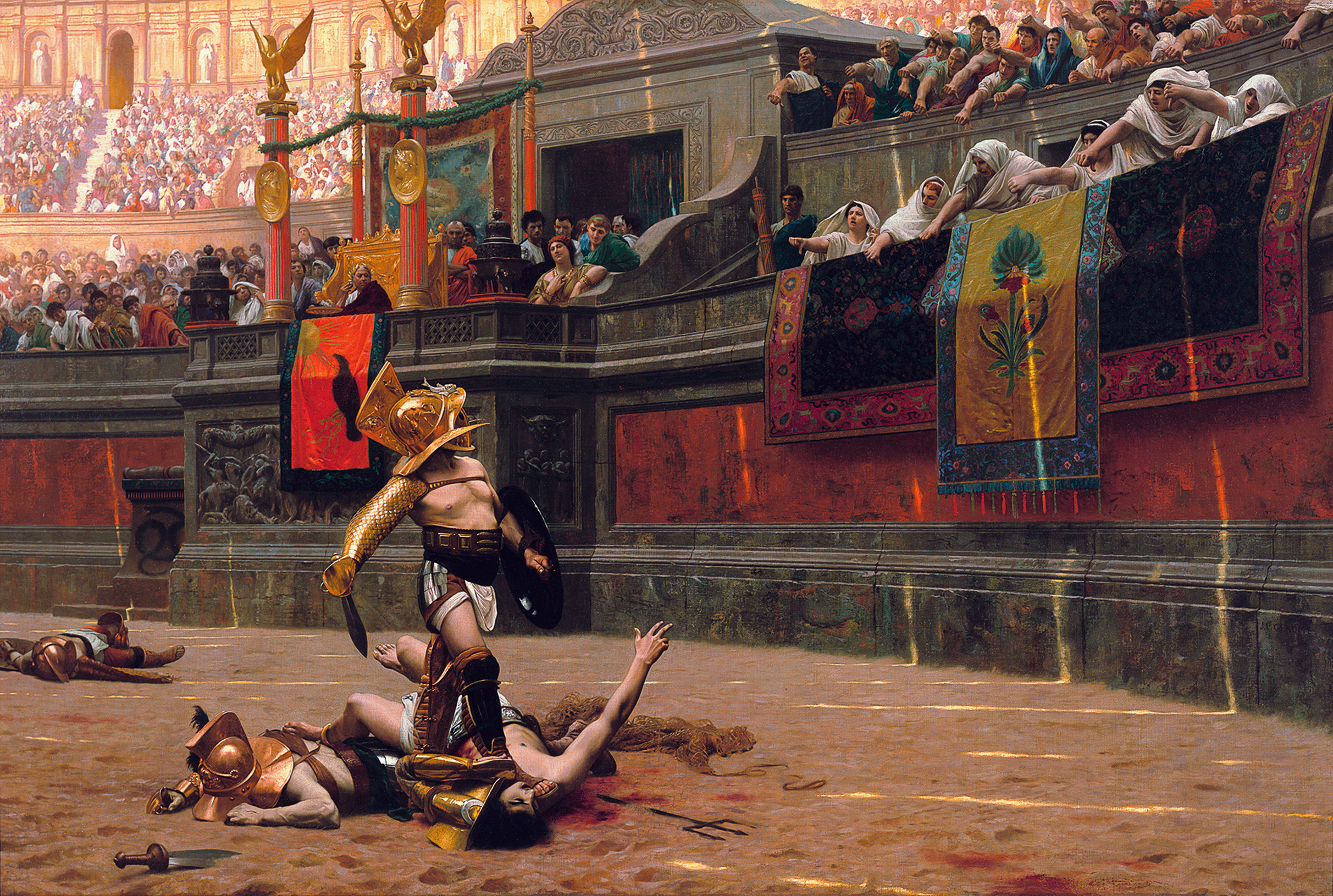
This is a painting I saw in the Museum of Fine Arts in Boston a few years ago. The painter, William Paxton (1869-1941), was an American impressionist who studied in Boston and Paris, under Jean-Léon Gérôme (of Police Verso fame).  Gérôme instilled a practice of the faithful modelling of the human form in Paxton; triumphantly achieved here in this beautifully lit study.

Odalisque by Frederick Arthur Bridgman


This is a particularly enticing looking odalisque by the American orientalist painter Frederick Arthur Bridgman (1847-1928).  Originating, like the airmen, in Tuskegee, Alabama, he studied in Paris under Gérôme  (of Pollice Verso fame).  He spent a lot of time in Algeria and Egypt, making sketches and collecting clothing and props to give his paintings an authentic air.  Many of his paintings were accurate records of life in North Africa at the time but he produced a fair number of more exotic odalisques as well and none more enticing than this one.  Like all orientalist painters, his work fell out of fashion from the mid nineteen fifties but now they can  fetch $250,000 and up.

Tropic evening by John LaGatta


Tropic evening (1933)


Today's artistic distraction comes from one of America's finest illustrators, John LaGatta (1894-1977).  LaGatta was born in Naples in 1894 and after his family moved to New York studied art at the New York School of Fine and Applied Arts, having first started off in his father's jewellery business. He first came to prominence during the period of the First World War, going on to do illustrations for the likes of Life, Saturday Evening Post, Ladies Home Journal and Cosmopolitan, together with advertising work. In 1916 he joined the Amsden commercial studio and never looked back. Unlike many later illustrators, who worked from photographs, LaGatta always used models, who he carefully selected himself.  LaGatta's family, although having aristocratic lineage, were very poor and later in life, as a successful illustrator, Lagatta very much appreciated the finer things in life. At the beginning of World War 2, LaGatta moved to California and taught at the Art Center School in Los Angeles. He died in 1977.


Women were very much LaGatta's favourite subject and even when depicting women in clothes (as he largely had to do for his magazine and advertising clients) his approach was unbelievably slinky; delivering some of the most sensual paintings of women ever produced.   Perhaps surprisingly, this rather daring nude was produced for a lipstick advertisement in 1933; one of a series he did in the late twenties and early thirties.  I can't see you being able to get away with an image like this in an American women's magazine today!

Ariadne asleep on the island of Naxos by John Vanderlyn


Ariadne asleep on the island of Naxos (1815) is by the American artist, John Vanderlyn.  Vanderlyn, a New Yorker, was the first American artist to study in Paris and the first to have a painting accepted by the Paris Salon.  This was really the first major nude by an  American painter.  Needless to say, when it was first displayed in America in 1815, its sensual approach caused controversy and as late as the 1890s, when it was firmly esconced in the Pennsylvania Academy's collection, there were protests against its "flagrant indelicacy" and calls for it to be removed from display.  The Legatus saw this painting in the Pennsylvania Academy on a visit to Philadelphia (a city with a fine artistic tradition) a few years ago.